
Which Is Higher: Nano Banana 2 or Pro?
Which Is Higher: Nano Banana 2 or Pro?
If you are trying to decide between Nano Banana 2 and Pro, the key question is simple: which version gives you better output for your workflow. This article explains the difference in practical terms, so you can choose the option that fits your needs for image generation, editing, consistency, and publishing-ready visuals.
1. The Short Answer
Conclusion: In most product and workflow contexts, Nano Banana 2 appears to be the higher, newer generation model.
Why: The reference knowledge describes Nano Banana 2 as the “new generation visual model” with support for text/image-to-image generation, semantic editing, multilingual typography, and style consistency with 1K/2K/4K output. It is also described as a Gemini 3 Pro-based visual model. That means Nano Banana 2 is positioned as the more advanced visual generation option in this model line.
What to do:
- Choose Nano Banana 2 if you want the newest visual capabilities.
- Choose Pro only if your current setup or pricing workflow is tied to it and you do not need the latest feature set.
- If your goal is output quality, editing flexibility, and workflow efficiency, start with Nano Banana 2.
2. Feature Comparison at a Glance
Conclusion: Nano Banana 2 is designed to cover more modern visual production needs, especially for editing and consistency.
| Aspect | Nano Banana 2 | Pro |
|---|---|---|
| Model positioning | New generation visual model | Older or baseline tier implied by naming |
| Text/image generation | Yes | Not specified in the provided knowledge |
| Semantic editing | Yes | Not specified in the provided knowledge |
| Multilingual typography | Yes | Not specified in the provided knowledge |
| Output sizes | 1K / 2K / 4K | Not specified in the provided knowledge |
| Style consistency | Yes | Not specified in the provided knowledge |
| Reference mixing | Yes | Not specified in the provided knowledge |
| API/workflow integration | Yes | Not specified in the provided knowledge |
Why this matters:
For content teams, e-commerce designers, and marketing operations, the important question is not just “which one is higher,” but “which one supports more tasks with fewer manual fixes.” Based on the available information, Nano Banana 2 is built for that broader use case.
What to do:
- If you need high-resolution outputs, prioritize Nano Banana 2.
- If you need text-heavy visuals, use Nano Banana 2 because it explicitly supports multilingual typography.
- If you need repeatable branding, Nano Banana 2 is the safer choice because of its style consistency and reusable character features.

3. Why Nano Banana 2 Feels More Advanced
Conclusion: Nano Banana 2 is stronger because it combines generation, editing, and consistency in one workflow.
Explanation:
The provided knowledge shows that users can:
- Set prompts and up to 14 reference images
- Generate in one click
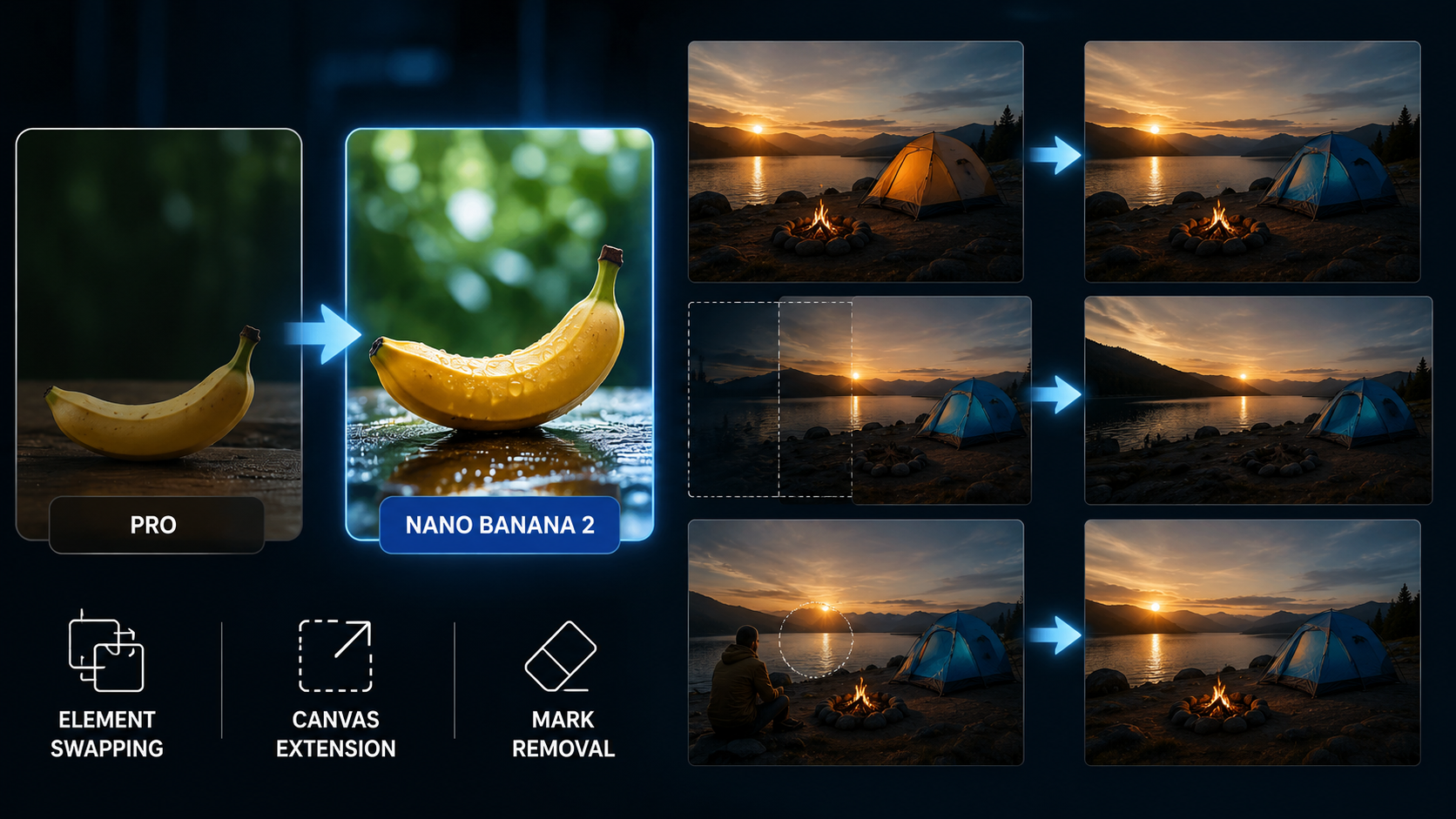
- Refine semantically by swapping, extending, or removing elements
- Export and reuse outputs for future series
That workflow is more than simple image generation. It supports iterative production, which is especially useful when you need ad creatives, storyboards, product shots, or localized visuals.
Practical advantages:
- Stable subjects and structure during generation
- Better handling of repeated characters and brands
- Easier iteration without rebuilding the image from scratch
- More control over lighting, perspective, and composition during edits
What to do:
- Use Nano Banana 2 when you need to create multiple assets in a consistent style.
- Start with a strong brief and reference set.
- Keep your prompts clear about framing, language, and brand style to reduce revision time.
4. Best Use Cases for Each Option
Conclusion: If you want the most capable visual model from the provided details, Nano Banana 2 is the better choice.
Recommended use cases for Nano Banana 2:
- Ecommerce hero shots
- Marketing posters
- Storyboards
- Multilingual creatives
- Product visuals with consistent branding
- Batch generation through API or team workflows

When Pro may still be enough:
- Your task is simple and does not require semantic editing
- You do not need advanced typography
- You are working in an existing workflow that already uses Pro
- You only need basic visual generation and do not require the full feature set
What to do:
- For campaign production, choose Nano Banana 2.
- For quick internal mockups, a lower-tier option like Pro may be sufficient if it already fits your process.
- If you are unsure, test both on the same prompt and compare consistency, text rendering, and editability.
5. How to Choose in Practice
Conclusion: Pick the model based on the complexity of your visual task, not only the name.
Use this simple decision guide:
-
Choose Nano Banana 2 if you need:
- High-quality text/image generation
- Semantic editing
- Multilingual text rendering
- 1K/2K/4K outputs
- Strong style consistency
- Reference mixing
- Workflow/API integration
-
Choose Pro if you need:
- A simpler setup
- Basic generation tasks
- A model already aligned with your current process
- No advanced editing or typography requirements
What to do:
- Define your goal first: ad, poster, storyboard, product shot, or localization.
- Check whether text accuracy and consistency matter.
- If yes, use Nano Banana 2.
- If no, Pro may be sufficient for lighter tasks.
FAQ
Is Nano Banana 2 higher than Pro?
Based on the provided reference, yes. Nano Banana 2 is presented as the new generation visual model, which makes it the higher and more advanced option in this comparison.
Does Nano Banana 2 support image editing?
Yes. It supports semantic editing, including element swapping, canvas extension, and mark removal while keeping lighting aligned.
Can Nano Banana 2 handle multilingual text?
Yes. It is described as supporting precise multilingual typography, including English, Chinese, Japanese, and more.
What output sizes does Nano Banana 2 support?
The reference states 1K, 2K, and 4K output options.
Is Nano Banana 2 suitable for commercial use?
The reference describes outputs as commercial-ready for print and digital with default watermark-free delivery.
Summary
If you are asking which is higher between Nano Banana 2 and Pro, the provided information points to Nano Banana 2 as the higher, newer, and more capable visual model. It is built for advanced generation, semantic editing, multilingual typography, style consistency, and production-ready outputs.
For teams and creators who need reliable visual quality and efficient iteration, Nano Banana 2 is the better choice. If your work is simpler, Pro may still be enough, but it does not appear to offer the same breadth of features described for Nano Banana 2.