
Is Nanobanana Pro Free Worth Using? Performance, Limits, and Who It’s Best For
Is Nanobanana Pro Free Worth Using? Performance, Limits, and Who It’s Best For
If you’re evaluating nanobanana pro free, the real question is not just “Is it free?” but “Does the free version give you enough speed, quality, and flexibility to support your workflow?”
Based on the product information available, Nanobanana Pro is positioned as a browser-based visual model for text-to-image, image-to-image, semantic editing, multilingual typography, and style-consistent generation. It supports 1K/2K/4K output, reference mixing, object swapping, and even API/workflow integration. That makes it attractive for creators who need more than simple image generation.
This article compares the practical value of nanobanana pro free across key decision factors, so you can decide whether it fits your needs or whether you should look for another option.
Quick Verdict
Nanobanana Pro Free is worth trying if you need:
- Fast visual iteration in the browser
- Text and image generation with editing support
- Strong typography and multilingual design
- Brand-consistent or character-consistent visual output
- Commercial-style outputs for marketing, ecommerce, or storyboarding
It may not be enough if you need:
- Heavy production volume without limits
- Deep enterprise controls or guaranteed SLA-level support
- Full creative freedom without model constraints
- Very specialized photo-editing precision
Evaluation Criteria
To make the comparison useful, this review uses five decision dimensions:
-
Performance
Generation speed, output quality, and consistency. -
Creative Flexibility
Whether the model supports multiple inputs, semantic edits, and style reuse. -
Practical Limits
Resolution options, workflow constraints, and likely friction points. -
Best-Fit Use Cases
The kinds of tasks where it delivers the most value. -
Decision Value
Whether the feature set is strong enough to justify using the free version as a primary tool or only as a trial.
Feature Comparison Table
| Dimension | Nanobanana Pro Free | Best For | Main Strength | Main Limitation |
|---|---|---|---|---|
| Speed | First-pass output in about 10–30 seconds | Rapid iteration | Fast browser-based generation | May not replace full production pipelines |
| Image Quality | Supports 1K / 2K / 4K output | Marketing and presentation visuals | High-resolution export options | Quality still depends on prompt and references |
| Editing | Semantic refine, object swap, canvas extension | Iterative visual work | Keeps lighting and composition aligned | Not meant for every niche retouching need |
| Text Handling | Multilingual typography support | Posters, ads, ecommerce visuals | Good for English, Chinese, Japanese, and more | Complex typography still needs review |
| Consistency | Reference mixing, reusable styles, reusable characters | Brand and storyboard work | Strong style and subject continuity | Requires well-prepared references |
| Collaboration | API and workflow integration | Teams and automation | Good for batch and system integration | Free usage may be less suited for scaling |
| Commercial Readiness | Watermark-free delivery by default | Business use | Clean exports for digital and print | Users should still check licensing terms |
| Accessibility | Runs in browser | Solo creators and small teams | Low setup friction | Less control than local pro tools |
What Nanobanana Pro Free Does Well
1. Fast first-pass generation
One of the biggest advantages of nanobanana pro free is speed. The model is designed to produce a first output in roughly 10–30 seconds, which is excellent for creators who want quick iteration instead of waiting on long render cycles.
Suitable for:
- Designers testing multiple ad concepts
- Marketers building campaign drafts
- Founders creating visual mockups
- Content teams needing rapid visual exploration
Strength:
- Helps you validate ideas quickly
Limitation:
- Fast output does not always equal final-quality output on the first try
Best use case:
- Early-stage ideation and concept testing
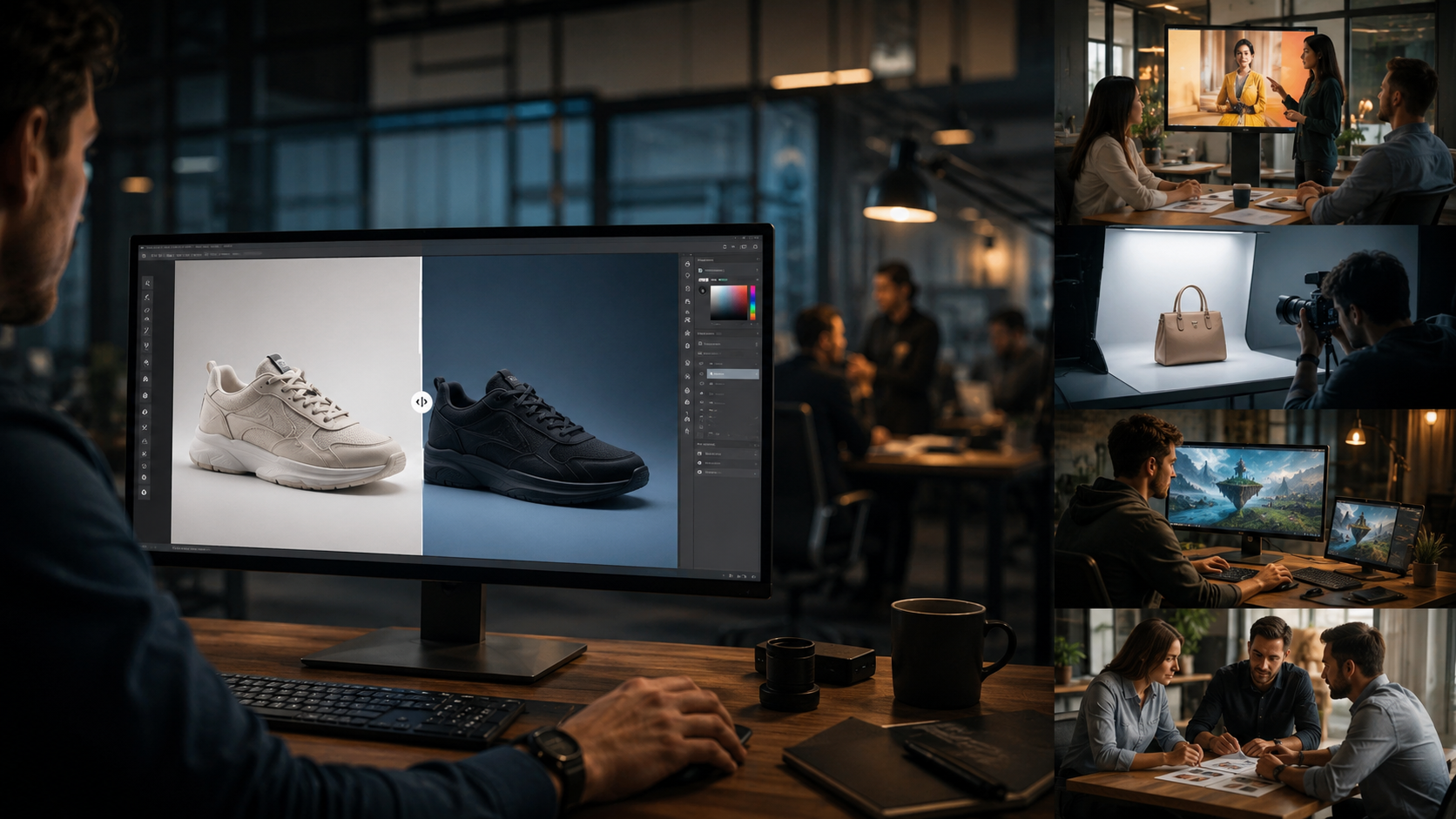
2. Strong image editing and semantic refinement
This model is not only for generating images from text. It also supports semantic editing, including:
- Swapping objects
- Extending the canvas
- Removing marks or unwanted elements
- Adjusting mood while keeping lighting aligned
That is a major advantage for users who need to revise visuals without starting over.
Suitable for:
- Marketing teams refining promotional visuals
- Ecommerce teams polishing product images
- Creators adjusting scenes for storytelling
- Agencies making rapid client revisions
Strength:
- Lets you change parts of an image while preserving the overall structure
Limitation:
- Not a full replacement for advanced manual editing software
Best use case:
- Iterative design workflows where small visual changes matter
3. Excellent multilingual text rendering
Many image models struggle with readable text. Nanobanana Pro is designed with precision text rendering and supports multiple languages, including:
- English
- Chinese
- Japanese
- More multilingual typography use cases
This makes it especially useful for poster design, ads, and branded content.
Suitable for:
- Global marketing teams
- Localized campaign design
- Social media creatives
- Retail and ecommerce promotional assets
Strength:
- Better than average at embedding text into images cleanly
Limitation:
- Very long copy or highly stylized type still needs close review
Best use case:
- Posters, banners, packaging concepts, and multilingual ads
4. Reference consistency for branding and character reuse
A standout feature is the ability to mix multiple references while preserving:
- Characters
- Branding
- Materials
- Style consistency across scenes
That makes it valuable for series-based production, such as ad sets or storyboard sequences.
Suitable for:
- Brand teams
- Creative agencies
- Storyboard artists
- Product marketing teams
Strength:
- Supports repeatable visual identity across outputs
Limitation:
- Good consistency depends on clear and relevant reference inputs
Best use case:
- Multi-image campaigns and recurring character or brand assets
Where Nanobanana Pro Free May Fall Short
1. Free access may not fit high-volume production
Even if the free version gives useful functionality, free tiers usually come with practical constraints. The biggest issue is not always quality but scale.
If you need:
- Frequent batch generation
- Team-wide usage
- Automated high-volume workflows
- Dependable production throughput
then nanobanana pro free may feel more like a test environment than a complete business solution.
Best for:
- Individuals
- Small teams
- Proof-of-concept work
Less ideal for:
- Production-heavy agencies
- Enterprise content ops
- Always-on creative pipelines
2. Advanced editing is useful, but not unlimited
Semantic editing is powerful, but it does not mean every visual problem can be solved perfectly. Highly detailed retouching, complex product corrections, or exact pixel-level refinements may still require dedicated editing tools.
Best for:
- Scene-level adjustments
- Object replacements
- Composition refinements
Less ideal for:
- Precision retouching
- Complex photo restoration
- Highly technical image manipulation
3. Output quality depends on input quality
Like most multimodal systems, the quality of results depends heavily on:
- Prompt clarity
- Reference image quality
- Style consistency
- Framing instructions
If your references are inconsistent, the output may also become inconsistent.
Best for:
- Users who can prepare clear briefs
- Teams with reference assets
- Repeatable workflows
Less ideal for:
- Users expecting one-click perfection from vague instructions
Best-Fit User Profiles
1. Solo creators and freelancers
Why it fits:
- Easy browser access
- Fast iteration
- Useful for posters, social content, and concept visuals
Strengths for this group:
- Low setup friction
- Broad creative coverage
- Good for pitching ideas quickly

Limits for this group:
- May not satisfy every advanced editing need
- Free version may be enough for testing, but not always for ongoing heavy use
Typical use cases:
- Social media posts
- Personal branding visuals
- Freelance client mockups
- Portfolio concept art
2. Marketing and ecommerce teams
Why it fits:
- Strong for hero shots, promotional banners, and product-style visuals
- Good typography support
- Clean export style suitable for campaigns
Strengths for this group:
- Fast creative turnaround
- Consistent visual language
- Supports multilingual marketing
Limits for this group:
- Free access may not support production scale
- Brand governance may require workflow controls beyond the free tier
Typical use cases:
- Launch campaigns
- Product promotions
- Seasonal ads
- Localized visuals
3. Agencies and content studios
Why it fits:
- Reference consistency
- Reusable styles and characters
- Useful for storyboards and ad variations
Strengths for this group:
- Efficient concept development
- Multiple iterations without rebuilding from scratch
- Good for client presentation work
Limits for this group:
- Free access may be too limited for client-facing throughput
- Agencies may need stronger integration and usage reliability
Typical use cases:
- Campaign previsualization
- Storyboard production
- Brand creative exploration
4. Product and operations teams
Why it fits:
- API and workflow integration support
- Potential for batch generation and automation
Strengths for this group:
- Fits structured production flows
- Can reduce manual image creation work
Limits for this group:
- The free tier is likely best as a trial, not a full operational layer
- May not be robust enough for continuous automation at scale
Typical use cases:
- Internal content generation
- Catalog testing
- Automated creative experimentation
Comparison by Decision Scenario
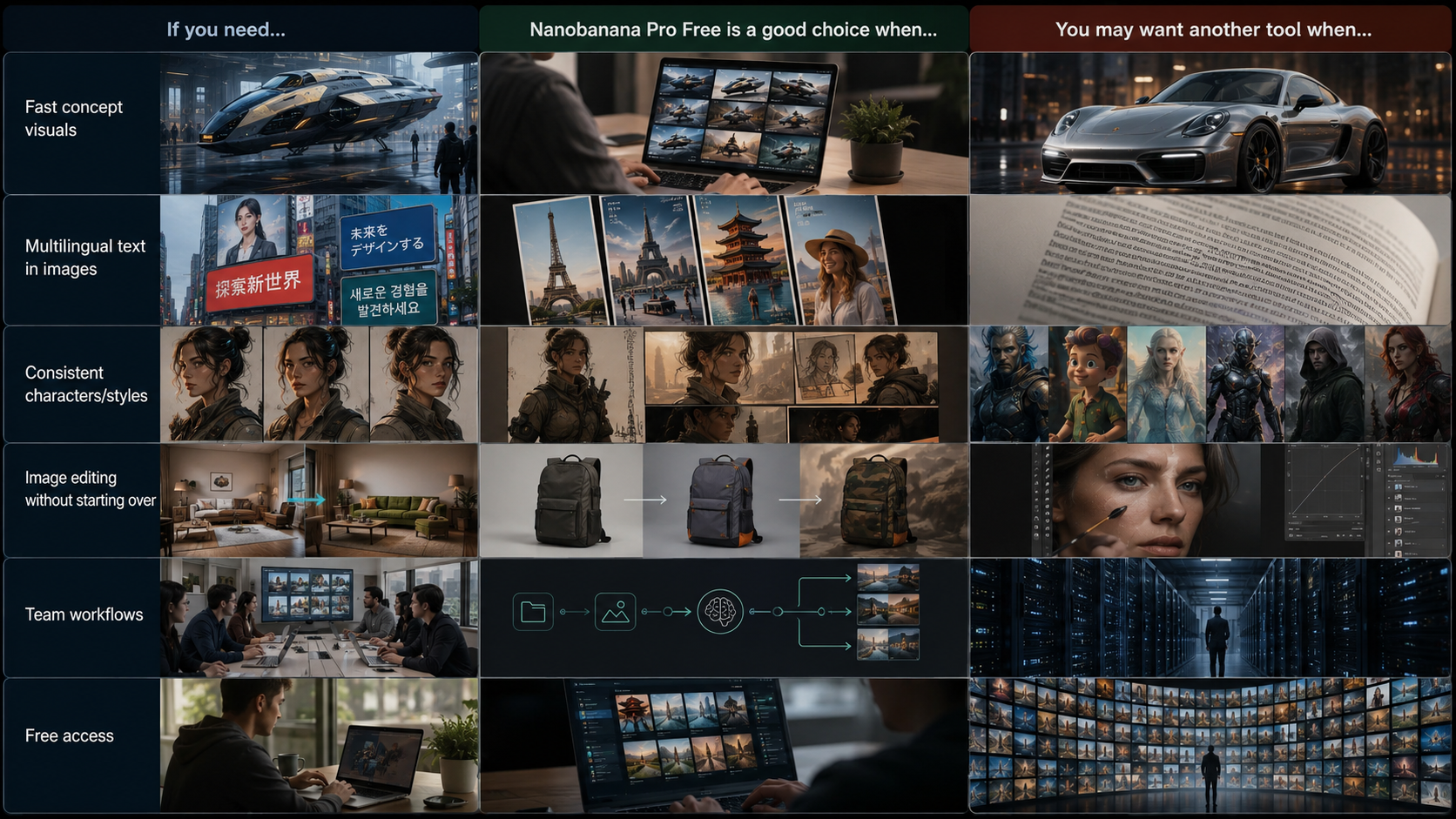
| If you need... | Nanobanana Pro Free is a good choice when... | You may want another tool when... |
|---|---|---|
| Fast concept visuals | You want quick browser-based iteration | You need final assets with minimal revision |
| Multilingual text in images | You need clean text for global campaigns | You require perfect long-form typography |
| Consistent characters/styles | You are making ad sets or storyboards | You need highly variable art direction |
| Image editing without starting over | You want object swaps or semantic refinements | You need deep manual retouching |
| Team workflows | You are testing an automated pipeline | You need production-grade scaling |
| Free access | You are evaluating the model | You need long-term high-volume usage |
Practical Recommendation
Choose Nanobanana Pro Free if:
- You want to test a modern visual model before paying
- You create marketing, ecommerce, or storyboard content
- You care about multilingual text and consistent branding
- You need fast iterations inside a browser
- You want a tool that combines generation and editing in one place
Skip it if:
- You need guaranteed enterprise-grade production capacity
- You rely on intensive batch creation every day
- You need professional-level pixel editing
- Your workflow is already locked into another image pipeline
Final Verdict by User Type
Best choice for:
- Solo creators exploring AI visual generation
- Marketers making posters, hero shots, and ads
- Teams that need visual consistency across variations
- Users who want to test a capable model without commitment
Good but not enough for:
- Busy agencies with high output demands
- Teams needing strong automation and operational scale
- Users who require advanced manual image control
Not recommended for:
- People expecting a free tool to replace full production workflows
- Users who need highly specialized editing precision
- Large organizations needing guaranteed capacity and governance
Conclusion
If your goal is to evaluate whether nanobanana pro free can handle real creative work, the answer is yes — for many common tasks, it is worth trying. Its strongest advantages are fast generation, semantic editing, multilingual typography, and style consistency. Those strengths make it especially useful for marketing, ecommerce, storyboards, and branded content.
However, the free version is best seen as a practical entry point, not necessarily a complete production solution. If you only need concepting, testing, or occasional content creation, it can be a very good fit. If you need scale, advanced control, or enterprise reliability, you should treat it as a trial and plan for a paid or more specialized tool later.
FAQ
What is Nanobanana Pro Free best used for?
It is best used for fast visual generation, image editing, multilingual text design, and consistent branded visuals.
Does Nanobanana Pro support image editing?
Yes. It supports semantic editing such as object swapping, canvas extension, and removing unwanted elements.
Is Nanobanana Pro suitable for commercial use?
The product description indicates watermark-free delivery and commercial-ready exports, but users should still review the applicable usage terms before deployment.
Can it handle multilingual typography?
Yes. It is designed for accurate text rendering across multiple languages, including English, Chinese, and Japanese.
Is the free version enough for teams?
It may be enough for testing and light use, but teams with high-volume production needs will likely need a more scalable plan.
Who should try Nanobanana Pro Free first?
Freelancers, marketers, ecommerce creators, and agencies exploring AI-driven visual workflows should try it first.
Bottom Line
Nanobanana Pro Free is worth using if you want fast, flexible, and visually consistent AI image generation with editing support.
It is especially strong for content creators, marketers, and teams that work with posters, ads, storyboards, or multilingual visuals.
If you need a tool for testing, prototyping, and day-to-day creative exploration, it is a strong candidate. If you need production-scale throughput or advanced manual control, treat the free version as a starting point, not the final answer.