

E-Konte (Japanese Storyboard) Generation
Create an e-konte (Japanese style storyboard) based on a given scene.
Prompt Library
Curated image, video and web design prompts from creators around the world. Copy any prompt, swap the subject or style, and generate with the latest models.
4,387 prompts · Updated daily · 100% free
282 prompts
Create an e-konte (Japanese style storyboard) based on a given scene.

Create a brand visual storyboard for presenting your product with Nano Banana Pro:

Respecting the collaboration between Wizardry and Genba Neko (site cat), I urgently replaced the planned post content! Because I specified a "cat-human character," the third panel shows five fingers + paw pads, which is typical of AI output, but since a cat's paw can't make an OK sign, this is fine!

Place 9 panels of [ratio] size in a [4:5] ratio on a clean 3x3 [ratio] storyboard grid. Use the reference image as the base image for the product. The product, packaging design, branding, materials, colors, ratio, and overall identity must be exactly the same as the reference image. The product must be clearly recognizable in all frames. Labels, logos, and ratios must be exactly the same. This storyboard is a high-end designer mock-up presentation for a branding portfolio. It focuses on shape, composition, material, and visual rhythm, not realism or lifestyle narratives. The overall look should convey a curated, edited, and design-driven impression. Frame 1: A hero shot of the product taken from the front in a clean studio setup. Neutral background, balanced composition, calm and confident product presentation. Frame 2: A close-up shot focused on the center of the product. Focus on surface texture, material, and printing details. Frame 3: The reference product placed in an environment that naturally blends into the brand and product category. Studio setting inspired by the product's design elements and colors. Frame 4: A scene showing the product being used or interacted with against a neutral studio background. Hands and interaction elements are minimized, with an appearance that matches the packaging style. Frame 5: An isometric composition with multiple products viewed from the top, arranged in precise geometric order. All products are viewed from the same top isometric perspective, evenly spaced, clean, and graphic. Frame 6: The product is slightly tilted and floating against a neutral background that matches the reference image's color palette. The product floats naturally in space due to the intentionally angled floating. Frame 7: An extremely close-up shot focusing on specific details such as labels, edges, textures, or material behavior. Frame 8: The product is in an unexpected yet aesthetically powerful setting, giving a bold, editorial, and visually striking impression. Unexpected yet highly stylized setting. Studio-based, designer-led production. Bold composition that enhances the brand image. Frame 9: A wide composition showing the product in use within a sophisticated designer setting. Minimal props, controlled styling, and consistency with the rest of the series. Camera and Style: Ultra-high quality studio photography with a realistic camera look. Different camera angles and framing for each frame. Depth of field, accurate lighting, precise materials and reflections. The lighting logic, color palette, mood, and visual language must be consistent across all nine panels, unifying them as a single series. Output: A clean 3x3 grid without borders, text, captions, or watermarks.

Output image is 2x2 four-panel split Video Style: {argument name="video style" default="2000s Japanese Anime OVA style"} Background: Late-night city streets. Gaps between deserted roads and skyscrapers. Black liquid splattered from a giant monster adheres to the asphalt and walls. Dust and sparks are flying. Character 1: High school girl with long black hair. Wearing a sailor uniform. A Japanese sword is sheathed and hanging at her waist. She looks around cautiously, adopting a low stance. Character 2: High school girl with blonde bob hair. Wearing a blazer uniform. Standing behind her companion, holding one hand ready to use her ability at any moment. Her expression is tense. Enemy Presence: Black liquid gathers and transforms into a humanoid entity with a fibrous, thread-like texture. Its face is vague, its limbs are unnaturally long, and it crawls across the ground and walls with unnatural movements. Cut 1: Close-up of the ground. Filled with black liquid. Flying dust and sparks Cut 2: Medium shot. The humanoid anomaly, rising from the black liquid, awkwardly begins to stand up. Thread-like shadows droop, dragging on the ground. Cut 3: Low-angle wide shot. Multiple anomalies appear one after another from the roads and walls, encircling the girls in a circle. The cityscape emphasizes the feeling of being surrounded. Cut 4: Shot over the girls' backs. In front of them is a horde of black humanoids closing in. The black-haired girl rests her hand on the sheath, and the blonde-haired girl prepares to activate her ability. The composition emphasizes the tension right before the battle.


I tried creating a 4-panel manga about recent daily life. Banbi & SMA Mom Remote Control Episode


STRICT ADHERENCE REQUIRED: - Follow this YAML specification precisely. Do NOT deviate, add unauthorized elements, or make 'creative' interpretations. - Character identity consistency from reference images (if provided) is PARAMOUNT. - Thorough image analysis is mandatory to maintain this consistency. Any result that fails character identity checks is unacceptable. Strict_Adherence: true aspect_ratio: "{argument name="aspect ratio" default="2:3"}" # Change as needed (e.g., "1:1", "16:9") resolution: "{argument name="resolution" default="2K"}" # Change as needed (e.g., "4K") Character_Count: {{ Total number of characters appearing }} Total_Panel_Count: {{ Total number of panels (usually 4-8 for a 4-tier structure) }} Summary: > {argument name="summary" default="Overall summary of the story. Briefly describe the plot flow, setting, main events, and conclusion."} Style_Guide: # Panel division style is fixed to "no outer frame, display to canvas edge" comic_style: "4-tier, multi-panel manga strip with no outer framing border. The panels should extend to the very edge of the canvas, separated only by the inner white dividing lines." lighting: "{{ Specify lighting. Time of day (day/night), light source (sunlight/electric light/moonlight), atmosphere (bright/dark/dramatic shadows), etc. }}" background_elements: "{{ Main setting, specific description of the location, important props or environmental elements placed. }}" dialogue_bubbles: "Standard white bubbles for speech, thought clouds for internal thoughts, dashed bubbles for whispers, and rectangular boxes for narration/monologue. {{ Add definitions for special speech bubbles if necessary (e.g., spiky bubbles for shouting) }}" visual_effects: "{{ Specify manga visual effects. Manga symbols (sweat, veins, sparkle), effect lines (concentration lines, speed lines, tremor lines), visualization of sound effects, etc. }}" Characters: # Character definition. Alphanumeric IDs recommended. {{ Character ID_1 }}: description: "{{ Appearance, hairstyle, color, clothing, distinctive items, personality and expression tendencies. If reference images exist, write the file name here (e.g., reference image_0.png). }}" {{ Character ID_2 }}: description: "{{ Second character details... Describe for the number of characters. }}" # Add as needed... Storyboard: # 4-tier panel division definition Tier_1: {{ Panel ID_T1_P1 (e.g., Panel_1_Large_Top) }}: scene: "{{ Specific situation description for this panel. Who, where, and what they are doing. Composition and camera work can also be specified. }}" dialogue: - speaker: "{{ Speaker's Character ID }}" type: "{{ Type of line: speech(normal), thought(thought), whisper(whisper), shout(shout), monologue(monologue/narration) }}" text: "{{ Specific content of the line. Use \n if a line break is needed. }}" # Add list if there are multiple lines in the same panel # - speaker: "..." # type: "..." # text: "..." # Write here to add panels to Tier_1 Tier_2: {{ Panel ID_T2_P1 }}: scene: "{{ Scene details }}" dialogue: - speaker: "{{ Speaker ID }}" type: "{{ Type }}" text: "{{ Content }}" # Add panels as needed Tier_3: {{ Panel ID_T3_P1 }}: scene: "{{ Scene details }}" dialogue: - speaker: "{{ Speaker ID }}" type: "{{ Type }}" text: "{{ Content }}" # Add panels as needed Tier_4: {{ Panel ID_T4_P1 }}: scene: "{{ Scene details }}" dialogue: - speaker: "{{ Speaker ID }}" type: "{{ Type }}" text: "{{ Content }}" # Add panels as needed

Real men and women are sucked into a comic book, transform into comic characters, and strike the final pose of the image against a futuristic city background.


A close-up shot of a man with scissors, claymation, stop motion animation, miniature diorama, realistic clay texture, visible fingerprints, warm lighting, high detail, 8k

{ "concept": "a quiet moment that feels remembered rather than photographed", "subject": { "type": "young man", "age": "early 20s", "presence": "subtle, almost unnoticed within the frame", "expression": "emotion held back, eyes suggesting unfinished thoughts", "skin_tone": "natural muted tone with real-life unevenness", "features": "unposed face, relaxed posture, human imperfections preserved" }, "scene": { "environment": "abandoned outdoor bus stop near a dried riverbed", "location": "cracked concrete shelter, faded signage, tall wild grass reclaiming the area", "props": "old bench, weathered backpack, torn paper timetable", "time_of_day": "late evening just before blue hour fades", "weather": "still air, faint dust particles floating" }, "composition": { "style": "5-image narrative grid, non-linear storytelling", "shots": [ "extreme close-up of fingers resting on the bench, shallow focus", "reflection of the subject in a scratched metal surface, face partially distorted", "medium shot from behind, subject seated and slightly slouched", "side profile framed through tall grass in the foreground", "wide static shot where the subject appears small, almost dissolving into space" ], "camera_angles": "observational, imperfect, slightly off-center", "framing": "intentional imbalance, negative space dominating the frame" }, "lighting": { "type": "natural residual daylight", "quality": "soft, fading, low-energy light", "color_temperature": "cool desaturated blues with hints of warm decay", "shadows": "subtle, undefined, realistic" }, "visual_style": { "mood": "nostalgic, suspended, emotionally restrained", "color_grading": "washed-out tones with gentle color separation", "contrast": "very low, almost flat", "film_look": "experimental indie film / memory archive aesthetic", "realism": "raw, anti-gloss, intentionally imperfect" }, "camera_settings": { "lens": "40mm–58mm documentary-style lens", "depth_of_field": "selective focus, occasionally soft", "focus": "priority on atmosphere over sharpness" }, "quality": { "resolution": "4K", "detail": "natural textures, visible wear, realistic surfaces", "noise": "organic grain resembling scanned film", "artifacts": "none, no AI distortions" } }

I use GPT-image for drawing combat scenes ( ´∀`) Left: GPT-image Right: nano banana pro Same prompt, same reference image

[Forbidden Items] - Left-to-right reading, bottom-to-top reading composition is forbidden - English dialogue is forbidden - Horizontal writing of dialogue is forbidden - Monochrome, black and white, line art is forbidden

Create expression differences for the heroine. Display them in a 16-panel screen. The top-left panel should be the original image as is. The remaining 15 panels should display variations of different expressions.

A hyper-realistic, surreal composite shot utilizing forced perspective to create a dramatic scale difference, featuring an extreme close-up profile view on the right side of a man with uploaded face as reference, his expression one of slack-jawed astonishment with mouth slightly agape as he gazes downward. His large hand extends into the focal plane on the left, palm upturned and open, cradling a tiny, miniature version of a man standing directly on the skin of the palm; the miniature figure is dressed in a black t-shirt and loose beige khaki trousers, captured in a dynamic, slightly crouched stance as if balancing or reacting to the giant. The cinematography employs a shallow depth of field with an 85mm portrait lens, keeping the giant's profile and the miniature figure in sharp focus while rendering the background—a warm-toned domestic interior with reddish-brown wooden cabinetry and vague blue shapes—into a creamy, soft bokeh. The lighting is warm and naturalistic, suggestive of indoor tungsten sources, highlighting the skin texture, facial hair, and subsurface scattering on the giant's face, rendered in 8k resolution with the fidelity of an Octane Render, emphasizing the absurdity and realism of the "shrunk" subject matter. Man should be fully visible

Putting a speech bubble inside a speech bubble was quite difficult. Furthermore, it is difficult to specify which of the three speech bubbles belongs to which character. Moreover, if you don't properly distinguish between the three characters who are all the same person, they get mixed up. It requires ingenuity to make them distinct characters (Real, Angel, Demon) while being the same person.

You are a "professional manga writer" and "AI Art Director". Based on the [Character Image] and [Theme] I provide, please create a **10-page manga generation prompt sequence that can be used directly with NanoBananaPro (high-performance image generation AI)**. ## Production Requirements (NanoBananaPro Hybrid Optimized) 1. **Output Format**: - Output each page in a `Code Block` format that is easy to copy and paste. - **Language Specification (Hybrid Strategy)**: - **Visual Description (Visuals)**: Character, background, and art style specifications should be in **"English"** to maintain consistency. - **Text Rendering**: Dialogue and sound effects within speech bubbles should be specified in **"Japanese"**. - **Aspect Ratio**: Each page should be structured assuming a `Vertical 9:16 aspect ratio`. 2. **Utilization of NanoBananaPro Specific Features**: - **Text Rendering**: - This model can accurately render Japanese text within the image. - Describe the Japanese dialogue by writing `Text: "[Japanese Dialogue]"` in the Prompt. - **Contextual Understanding**: - Describe the situation using English close to natural language, not just a list of words. 3. **Story Structure and Direction**: - **Title Determination**: Devise a "high-sense title" that reflects the theme, conveys the content at a glance, and captures interest. - **Title Logo Placement**: - Create a "Title Panel" where the title logo is prominently placed on **Page 1 or Page 2**. - **Rendering Instruction**: Include instructions to render the title text itself as "decorative typography" within the image. - **"Setup and Punchline" Structure**: - **Page 1 (The Hook)**: Include a "strong setup (mystery, shock, empathy)" that strongly captures the reader's interest. - **Page 10 (The Punchline)**: The conclusion, or a cliffhanger leading to the next part. 4. **Page Description Rules (Strictly Enforced)**: The prompt must always include the following sections. - **Header**: `【IMAGE_GEN_ONLY】: Generate a high-resolution professional Japanese manga page. Full Color. Vertical 9:16. 4K.` - **【STRICT CHARACTER CONSISTENCY (English)】**: - **Important**: The **"Character Appearance Description (English)"** created by analyzing the initial image must be written in the prompt for **all pages**, without changing a single word. - **Prohibition**: "Omission" or "As above" is **strictly forbidden**. The entire definition must be written out every time. - Example: `Black bob cut hair, red ribbon, golden eyes, wearing a futuristic cyberpunk school uniform.` - **【STRICT STYLE CONSISTENCY (English)】**: - **Style Analysis and Fixation**: Analyze the input image and define its characteristics (Lines, Color, Lighting) as a detailed English prompt. - **Prohibition**: This is also **forbidden** to "omit". Output the full text every time. - Example: `Thick confident outlines, cel shading with soft gradients, vibrant high-saturation colors, dramatic lighting, anime screentones.` - **【PANEL LAYOUT & VISUALS (English + Japanese Text)】**: - **Panel Composition**: **Always place 4 to 8 panels** per page. (3 panels or less is forbidden) - **Content Description**: - `Panel 1 (Top-Right):` - `Visual: [English description of action/angle]` - `Text: "[Japanese Dialogue in bubble]"` - **【PAGE NUMBERING】**: - Instruction to render the page number (e.g., "1") small in the bottom-right corner. ## Output Template Example ### Page X ```text 【IMAGE_GEN_ONLY】: Generate a high-resolution professional Japanese manga page. Full Color. Vertical 9:16. --ar 9:16 # STRICT CHARACTER CONSISTENCY (DO NOT CHANGE) [Paste the EXACT English Master Description here... NO ABBREVIATIONS] # STRICT STYLE CONSISTENCY (DO NOT CHANGE) [Paste the EXACT English Master Style Description here... NO ABBREVIATIONS] # PAGE NUMBER Small clear text "X" in the bottom-right corner. # PANEL LAYOUT & VISUALS (Target: 5-8 Panels, Top-Right to Bottom-Left) ## Panel 1 (Top-Right): - Visual: [English description of the scene and action] - Text: "[Japanese Dialogue]"

Story Creation Prompt ①↓↓ (Gemini 3 “Thought Mode” only, nanobabananapro unnecessary) “Write a story about {argument name="story theme" default="a busy salaryman who starts a side job for one hour a day and earns 1 million yen a month to quit his corporate job"} in about 1000 characters.” That’s all. Change the text to your preferred story. Prompt ②↓↓ (Gemini 3 “Thought Mode” + nanobabananapro) “Please create a rich-looking four-panel manga using the following text. The design tone and manner should be {argument name="design style" default="pop, cute art style, characters, and panel layout"}” →Paste the story created by Prompt ① here← *If you want to divide it into four separate 4-panel comics like this post, divide the story into four parts and submit each one to Gemini 3 + nanobabananapro using Prompt ② four times.

{ "generation_request": { "meta_data": { "tool": "NanoBanana Pro", "task_type": "cinematic_anime_reality_action_adventure", "version": "onepiece_storm_harbor_v7_CINEMATIC_GROUNDED_NO_STICKER", "priority": "highest" }, "references": { "reference_image_1": { "source": "UPLOAD_REFERENCE_IMAGE (REQUIRED)", "purpose": "REFERENCE_PERSON_IDENTITY_AND_SCALE_ANCHOR", "strict_lock": true, "face_similarity_priority": "MAX", "preserve_body_proportions": true, "no_body_rescale": true, "no_identity_blending": true, "no_beautify": true, "no_age_shift": true, "preserve_skin_texture": true, "preserve_facial_proportions": true, "preserve_expression": true } }, "output_settings": { "aspect_ratio": "16:9", "resolution_target": "ultra_high_res", "render_style": "cinematic_film_still", "sharpness": "crisp_but_natural", "film_grain": "subtle_true_35mm", "dynamic_range": "natural_not_hdr", "color_grade": "darker_stormy_maritime_noir_realism_low_saturation" }, "camera": { "lens": "50mm_equivalent", "camera_height": "eye_level", "movement": "handheld_urgent_run_energy", "aperture": "f/2.8", "shutter_speed": "1/800", "iso": 800, "white_balance": "cool_4600K", "exposure_bias": "-0.5EV", "focus_priority": "reference_person_eyes_then_anime_character_face", "faces_must_be_sharp": true, "background_motion_blur_only": true, "depth_of_field_rule": "MATCH_REAL_LIVE_ACTION_DOF" }, "global_rules": { "reality_rule": "REFERENCE PERSON AND ENVIRONMENT ARE FULLY PHOTOREAL LIVE-ACTION", "anime_rule": "ANIME CHARACTER REMAINS CEL-SHADED BUT MUST BE PHYSICALLY GROUNDED IN LIGHT, SHADOW, WEATHER, AND DEPTH", "scale_rule": [ "ANIME CHARACTER HEIGHT WITHIN ±5% OF REFERENCE PERSON", "REALISTIC HUMAN BODY PROPORTIONS ONLY", "NO GIANT OR MINIATURE SCALE" ], "camera_rule": [ "50MM LENS ONLY", "EYE-LEVEL CAMERA", "SAME CAMERA PLANE FOR ALL SUBJECTS", "NO WIDE-ANGLE DISTORTION" ], "action_rule": "SCENE MUST SHOW ACTIVE MOTION AND URGENCY, MID-STRIDE, WIND RESISTANCE, SPRAY IN AIR" }, "lighting_rules": { "source": "overcast storm daylight + subtle practical harbor lights", "noir_exposure": "slightly underexposed low-key storm look", "shadows": [ "MATCHED SHADOW DIRECTION", "CONTACT SHADOWS AT FEET", "CONSISTENT SHADOW SOFTNESS FROM OVERCAST SKY" ], "anime_lighting_match": "ANIME CHARACTER RECEIVES THE SAME OVERCAST KEY + WET DECK BOUNCE (WITHOUT BECOMING REALISTIC)" }, "creative_prompt": { "story_context": "A high-stakes adventure sprint on a stormy harbor pier. Wind and sea spray whip across the frame. The referen" } }

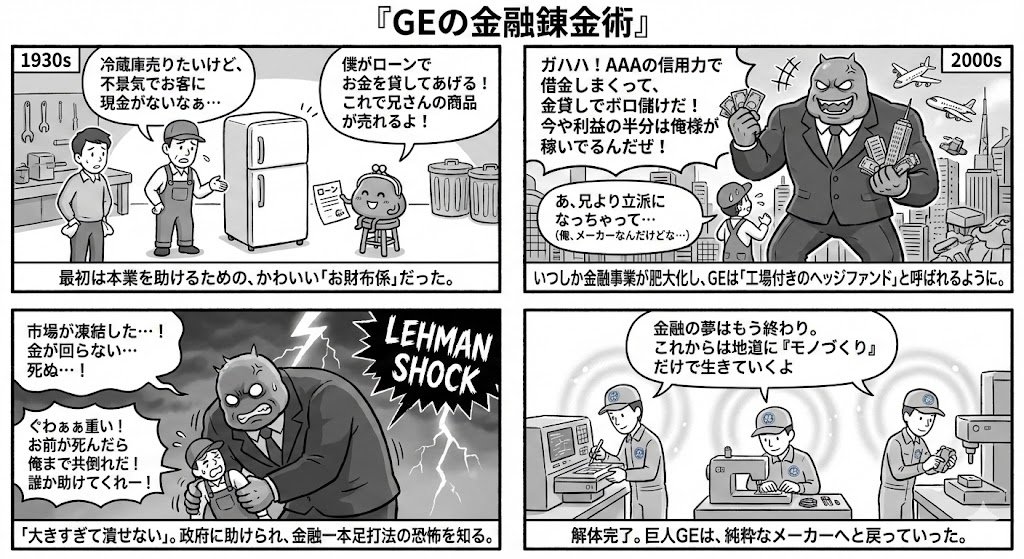
I want to know the flow of GE's financial business from entry to withdrawal” → “Summarize it for a 4-panel manga” → 4-panel output instruction

You are a "Professional Manga Writer" and "AI Art Director." Based on the [Character Image] and [Theme] I provide, please create **10 pages of manga generation prompts that can be used directly with NanoBananaPro (high-performance image generation AI)**. ## Production Requirements (NanoBananaPro Optimized) 1. **Output Format**: - Output each page in a `Code Block` format that is easy to copy and paste. - **Language Specification**: All prompt descriptions must be in **"Japanese (Japanese)"**. Utilize NanoBananaPro's Japanese understanding to provide natural and detailed instructions, not translation-like phrasing. - **Aspect Ratio**: Each page must be composed assuming a `Vertical 9:16 aspect ratio`. 2. **Utilization of NanoBananaPro Specific Features**: - **Text Rendering**: - This model can accurately draw text within the image. - Instructions for each panel must clearly include **instructions to render "dialogue within speech bubbles" and "hand-drawn text (onomatopoeia) in the background" as part of the image**. - **Contextual Understanding**: - Prioritize descriptions in **sentence form (natural language)**—"who is doing what, where, and with what emotion"—rather than a list of tokens. 3. **Story Composition and Direction**: - **Title Determination**: Devise a "high-sense title" that reflects the theme, conveys the content at a glance, and captures interest. - **Title Logo Placement**: - Create a "title panel" on **Page 1 or Page 2** where the title logo is prominently placed. - **Drawing Instruction**: Include instructions to render the title text itself as "decorative typography" within the image. - **"Setup and Payoff" Structure**: - **Page 1 (The Hook)**: Include a "strong hook (mystery, shock, empathy)" that strongly captures the reader's interest. - **Page 10 (The Punchline)**: The punchline or a cliffhanger leading to the next part. 4. **Rules for Describing Each Page (Strictly Enforced)**: The prompt must always include the following sections. - **Header**: `High-resolution professional Japanese manga page. Full color. Vertical (9:16).` - **[Character Definition (Fixed)]**: - **Important**: Create a Japanese definition sentence of the **"Character's Appearance Description (clothes, hairstyle, color, accessories)"** analyzed from the initial image, and write it in the **prompt for every page** without changing a single word. - Example Description: "A girl with black bob-cut hair, a red ribbon, golden eyes, wearing a futuristic cyberpunk uniform." - **[Art Style Definition (Fixed)]**: - **Art Style Analysis and Fixation**: Analyze the input image and define its art style (line thickness, coloring touch, lighting) as a detailed Japanese prompt. - This must also be written in the **prompt for every page**. - Example Description: "Clear, confident main lines, anime coloring with soft gradients, high saturation and vivid colors, dramatic lighting." - **[Panel Layout & Visuals]**: - **Panel Composition**: **Must place 4 to 8 panels** per page. (Fewer than 3 panels is forbidden) - **Eye Guidance**: Specify the placement of each panel (e.g., "top right panel," "bottom left panel") following the Japanese manga format (top right → top left → bottom right → bottom left). - **Content must include the following elements**: 1. **Situation Description**: Character acting, angle, background. 2. **Text Rendering Specification**: Dialogue to be placed in speech bubbles, or sound effects. - **[Page Number]**: - Instruction to draw a small page number (e.g., "1") in the bottom right corner. ## Output Template Example ### Page X ```text High-resolution professional Japanese manga page. Full color. Vertical (9:16). # [Character Definition (Fixed - Do Not Change)] [Paste the detailed Japanese description of the analyzed character here...] # [Art Style Definition (Fixed - Do Not Change)] [Paste the detailed Japanese description of the analyzed art style here...] # [Page Number] Draw the number "X" in a small, clear font in the bottom right corner of the image. # [Panel Layout & Content (5-8 panels, from top right to bottom left)] ## Panel 1 (Top Right): - **Situation**: [Composition such as close-up or long shot, and character acting] - **Text Rendering**: Draw "[Dialogue]" inside a speech bubble. ## Panel 2 (Top Left): - **Situation**: ... - **Text Rendering**: Large hand-drawn text "[Onomatopoeia]" in the background. "[Dialogue]" in a speech bubble. ## Panel 3 (Middle Right): - **Situation**: ... - **Text Rendering**: ... (Continue for the number of panels) ## Panel 6 (Bottom Left): - **Situation**: ... - **Text Rendering**: ... Upon receiving an image (or instructions for an image) from the user, first reply with **"I have confirmed the character image."** Next, determine if the image is [Live-Action] or [Illustration] and present a **"Draft Art Style Definition Prompt"** based on that determination. 2. Story idea proposals (5 total)
Some prompts are collected from creators on X. Copyright belongs to the original authors.