
Uncategorized
What Is Nanobananan? The Latest Nanobanana Guide for Smart Buyers
What Is Nanobananan? The Latest Nanobanana Guide for Smart Buyers If you’ve seen “nanobananan” mentioned online and wond

If you’ve seen “nanobananan” mentioned online and wondered what it means, you’re likely looking at a misspelling or nickname for Nano banana / Nano banana 2 — a next-generation visual model built for text-to-image, image-to-image generation, semantic editing, and consistent visual outputs.
This guide helps you compare, filter, and decide whether Nanobananan (Nano banana) is the right tool for your workflow. Instead of only describing features, we’ll evaluate it by practical decision factors:
- Output quality
- Text rendering accuracy
- Reference consistency
- Editing flexibility
- Batch and team workflow support
- Commercial usability
- Best-fit use cases
Quick Verdict
Nanobananan is best for users who need fast, high-quality visual generation with strong editability and style consistency.
It is especially useful when you want to create:
- ecommerce hero images
- marketing posters
- storyboard frames
- multilingual graphics
- product visuals with consistent branding
- edited images that preserve lighting and composition
If your priority is accurate typography, semantic editing, and reusable visual styles, Nanobananan stands out.
What Is Nanobananan?
Nanobananan generally refers to Nano banana, a Gemini 3 Pro-based visual model. According to the product information, it combines:
- text generation
- image editing
- multimodal understanding
- high-resolution output
- style consistency across multiple generations
The newer version, Nano banana 2, expands support for:
- text/image-to-image generation
- semantic editing
- multilingual typography
- 1K / 2K / 4K output
In simple terms, it is a visual AI tool designed not just to make images, but to make images that stay consistent, editable, and production-ready.
How We Evaluate Nanobananan
To help you decide whether this tool fits your needs, we compare it using six practical dimensions:
| Evaluation Dimension | What It Means | Why It Matters |
|---|---|---|
| Output Quality | Sharpness, detail, realism, and final image polish | Determines whether the image is usable for real projects |
| Text Accuracy | How well the model renders English, Chinese, Japanese, and longer copy | Critical for posters, packaging, and ads |
| Consistency | Whether characters, products, and styles stay stable across iterations | Important for campaigns and series content |
| Editing Flexibility | Ability to swap, remove, extend, or refine elements without breaking the image | Saves time in revision-heavy workflows |
| Workflow Efficiency | Speed, reference handling, batch use, API support | Matters for teams and content production |
| Commercial Readiness | Watermark-free output and suitability for print/digital use | Affects business adoption |
Nanobananan Feature Breakdown
| Feature | What It Does | Best For | Main Limitation |
|---|---|---|---|
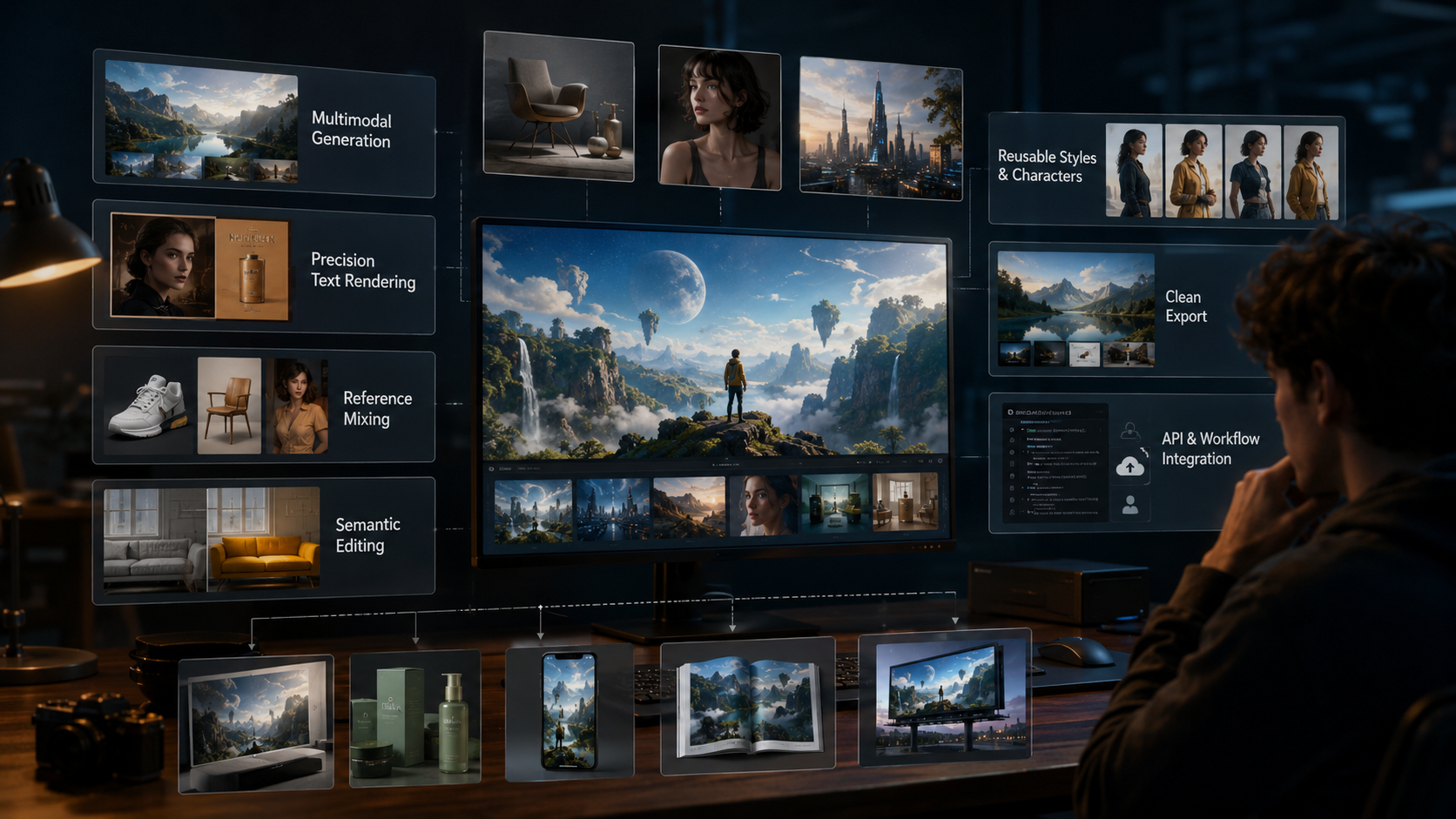
| Multimodal Generation | Creates visuals from text or images in 1K/2K/4K | Marketing, design, product visuals | May still require prompt and reference discipline |
| Precision Text Rendering | Produces accurate typography in multiple languages | Posters, packaging, multilingual ads | Complex layouts can still need review |
| Reference Mixing | Combines multiple references while maintaining coherence | Brand systems, character consistency | Too many references may reduce clarity |
| Semantic Editing | Replaces objects or adjusts scenes while preserving structure | Retouching, local edits, revisions | Not every change is equally predictable |
| Reusable Styles & Characters | Keeps roles, props, and shot language consistent | Storyboards, ad series, brand kits | Requires organized asset planning |
| Clean Export | Watermark-free, commercial-ready output | Print, web, sales materials | Export quality still depends on source inputs |
| API & Workflow Integration | Supports batch generation and team collaboration | Agencies, ops teams, automation | Best value appears at higher volume |
Who Is Nanobananan Best For?
1. E-commerce Teams
Suitable for: product marketers, online sellers, creative managers
Advantages:
- fast hero-shot generation
- clean commercial visuals
- easy iteration for product variants
- strong consistency for repeated listings
Limitations:
- may require brand-approved source images
- high-volume catalog work still needs workflow planning
Use cases:
- product launch banners
- marketplace hero images
- seasonal campaign visuals
- A/B testing of ad creatives
2. Marketing and Brand Teams
Suitable for: campaign designers, content marketers, brand studios
Advantages:
- maintains style consistency across assets
- supports multilingual typography
- good for poster-style and social visuals
- semantic edits reduce redesign time
Limitations:
- creative direction still matters
- advanced brand systems need consistent reference management
Use cases:
- promotional posters
- brand story visuals
- social media creative sets
- multilingual campaign assets
3. Designers and Creative Producers
Suitable for: visual designers, art directors, storyboard artists
Advantages:
- reusable characters and styles
- fast concept exploration
- strong scene continuity
- useful for storyboard development
Limitations:
- not a replacement for final design judgment
- may need manual refinement for exact layout control
Use cases:
- concept iteration
- storyboard sequences
- visual mood boards
- campaign previsualization
4. Agencies and Production Teams
Suitable for: agencies, content studios, outsourced creative teams
Advantages:
- batch generation
- API integration
- collaboration-friendly workflow
- reliable output for scalable production
Limitations:
- onboarding takes planning
- reference discipline is essential for quality control
Use cases:
- large campaign rollouts
- repeated client asset production
- automated visual generation
- collaborative review workflows
5. Multilingual Content Teams
Suitable for: international brands, cross-border sellers, localization teams
Advantages:
- multilingual text rendering
- supports English, Chinese, Japanese, and more
- useful for region-specific visuals

Limitations:
- typography still needs proofreading for mission-critical copy
- complex language layouts should be tested before release
Use cases:
- localized ad banners
- multilingual posters
- regional ecommerce creatives
- translated visual assets
Strengths and Limitations at a Glance
| Category | Strengths | Limitations |
|---|---|---|
| Image Generation | High-quality visuals with multiple output sizes | Best results depend on clear references and direction |
| Editing | Semantic refinements preserve structure and lighting | Complex edits may need multiple passes |
| Text Rendering | Strong multilingual typography support | Dense copy or unusual layouts may still require review |
| Consistency | Stable characters, materials, and branding across scenes | Needs disciplined asset input to stay consistent |
| Team Use | API and workflow integration for scale | More valuable in structured production environments |
| Commercial Use | Watermark-free, production-friendly exports | Users should still verify licensing and internal approvals |
When Nanobananan Is the Right Choice
Choose Nanobananan if you need:
- fast iteration with high-quality visual output
- consistent characters or products across multiple images
- multilingual text embedded in the design
- semantic editing without rebuilding the whole image
- commercial-ready graphics for digital or print
- batch generation or workflow integration for a team
It is especially compelling if you work on marketing, ecommerce, or content production pipelines where speed and consistency matter as much as visual quality.
When You May Want Something Else
Nanobananan may not be the best first choice if you:
- only need casual, one-off image generation
- do not need consistency across multiple assets
- prefer a fully manual design workflow
- require extremely specific layout control for print production
- have no use for multilingual text or edit-preserving generation
In other words, the more your work resembles repeatable production, the more value Nanobananan tends to offer.
Decision Guide: Which Type of User Gets the Most Value?
| User Type | Fit Level | Why |
|---|---|---|
| Ecommerce Seller | High | Needs fast product visuals and variations |
| Marketing Team | High | Needs campaign consistency and multilingual assets |
| Creative Agency | High | Benefits from scale, reuse, and API workflow |
| Freelance Designer | Medium to High | Good for concepting and rapid iteration |
| Localization Team | High | Strong support for multilingual typography |
| Casual Hobby User | Medium | Useful, but may be more powerful than necessary |
Practical Recommendation by Scenario
If you need fast product visuals:
Nanobananan is a strong choice because it supports high-resolution generation, image refinement, and commercial-ready exports.
If you need consistent campaign assets:
It is particularly valuable thanks to reference mixing, reusable styles, and character consistency.
If you need multilingual design:
Its typography support makes it more useful than many generic image tools.
If you need team-scale production:
The API and workflow integration make it a better fit than a standalone image generator.

If you only need occasional AI images:
You may find it powerful, but possibly more advanced than your needs.
FAQ
What does “Nanobananan” mean?
It usually refers to Nano banana, a visual AI model for text/image generation and editing. The spelling may vary in online discussions.
Is Nanobananan the same as Nano banana 2?
In practice, the guide points to Nano banana 2 as the newer generation of the model, with expanded capabilities such as 1K/2K/4K output, semantic editing, and multilingual typography.
Can Nanobananan handle text in images?
Yes. One of its notable strengths is precision text rendering, including support for English, Chinese, Japanese, and more.
Is it useful for commercial work?
Yes. The product information highlights watermark-free delivery and commercial-ready outputs for print and digital use.
Can I keep the same character or style across multiple images?
Yes. The model supports reference mixing, reusable styles, and reusable characters, which helps maintain consistency across a series.
Does it support team workflows?
Yes. It offers API support and workflow integration, making it more suitable for batch generation and team collaboration.
Final Recommendation
Best overall for:
- marketing teams
- ecommerce brands
- agencies
- multilingual content production
- visual workflows that need consistency
Best if you care most about:
- fast iteration
- high-resolution output
- semantic editing
- text accuracy
- repeatable visual identity
Less ideal for:
- casual users who only need occasional image generation
- workflows that require highly manual, pixel-level design control
Bottom Line
If your goal is to create professional visuals that stay coherent, editable, and production-ready, Nanobananan is a strong contender. It is not just an image generator; it is a visual production tool built for users who care about quality, consistency, and scalable creation.
If you are comparing tools for business or content operations, Nanobananan is most worth considering when your work depends on speed, multilingual assets, and reliable visual repetition.